Writing by hand to understand yourself: what the evidence says
· 8 min
People who keep a journal tend to say the same thing: they don’t know what they think until they have written it down. That is a claim about self-knowledge, and there is a good deal of research behind it. Some of it is strong, some is weaker than the headlines suggest. This is a tour of both.
The original experiment
In 1986 James Pennebaker and Sandra Beall asked students to write for fifteen minutes on four evenings in a row. Some wrote about the most upsetting experience of their lives; others wrote about trivial things. In the following months, the students who had written about both the facts and their feelings visited the health centre less often than the rest (Pennebaker & Beall, 1986).
The study was small, but the method has since been repeated hundreds of times. A 1998 analysis of 13 experiments in healthy people found a medium-sized benefit across health and wellbeing measures (Smyth, 1998). The largest review, of 146 randomised studies, found the effect was real but small (Frattaroli, 2006). A plain-language summary by two psychiatrists is free to read (Baikie & Wilhelm, 2005).
So: writing about what matters to you helps a little, on average, and for some people a lot. It is not a cure for anything.
Why it might work: making sense
The interesting part is the mechanism. Pennebaker analysed the words people used across their writing days. Those whose health improved most were not the ones who vented hardest. They were the ones whose writing changed: more words like because, realise and understand on later days than on the first (Pennebaker, 1997). They were building an explanation.
Two other findings point the same way:
- Naming a feeling quiets it. In brain scans, putting a word to an emotion reduced the amygdala’s response to upsetting images (Lieberman et al., 2007). That study used labels, not journals, but a journal is a place where naming happens.
- Writing frees up attention. Students who wrote about their thoughts and feelings on starting university later did better on working memory tests than students who wrote about everyday topics, and reported fewer intrusive thoughts (Klein & Boals, 2001).
Put together, the picture is that writing turns a loop of half-formed worry into a story with causes in it. A story can be examined. That is what people mean by self-discovery: seeing your own reasons laid out.
Does it have to be by hand?
Honestly: the expressive writing research doesn’t say. Most early studies used pen and paper because that is what there was; later ones used keyboards and still found benefits, including a twelve-week online journaling trial that reduced distress in anxious medical patients (Smyth et al., 2018).
There are reasons to think the pen helps, and they are worth stating at their real strength:
- Handwriting engages the brain differently. EEG recordings of 36 students showed more widespread connectivity when writing words by hand than when typing them (Van der Weel & Van der Meer, 2024). Whether that leads to better thinking is a step the study didn’t test, as a published critique pointed out.
- Handwriting is slow. You can’t write as fast as you think, so you choose. Many people find the choosing is where the insight is. This is experience more than data.
- A notebook has no notifications. Nothing on paper interrupts a hard thought.
More on the handwriting studies in handwriting versus typing: what the research shows. The fair summary is that writing is what matters most, and handwriting is a good way to make yourself do it slowly and without distraction.
A way to start
- Fifteen minutes, three or four days running. That is the protocol the studies used.
- Write about what is actually on your mind, facts and feelings both.
- Don’t edit. Nobody will read it.
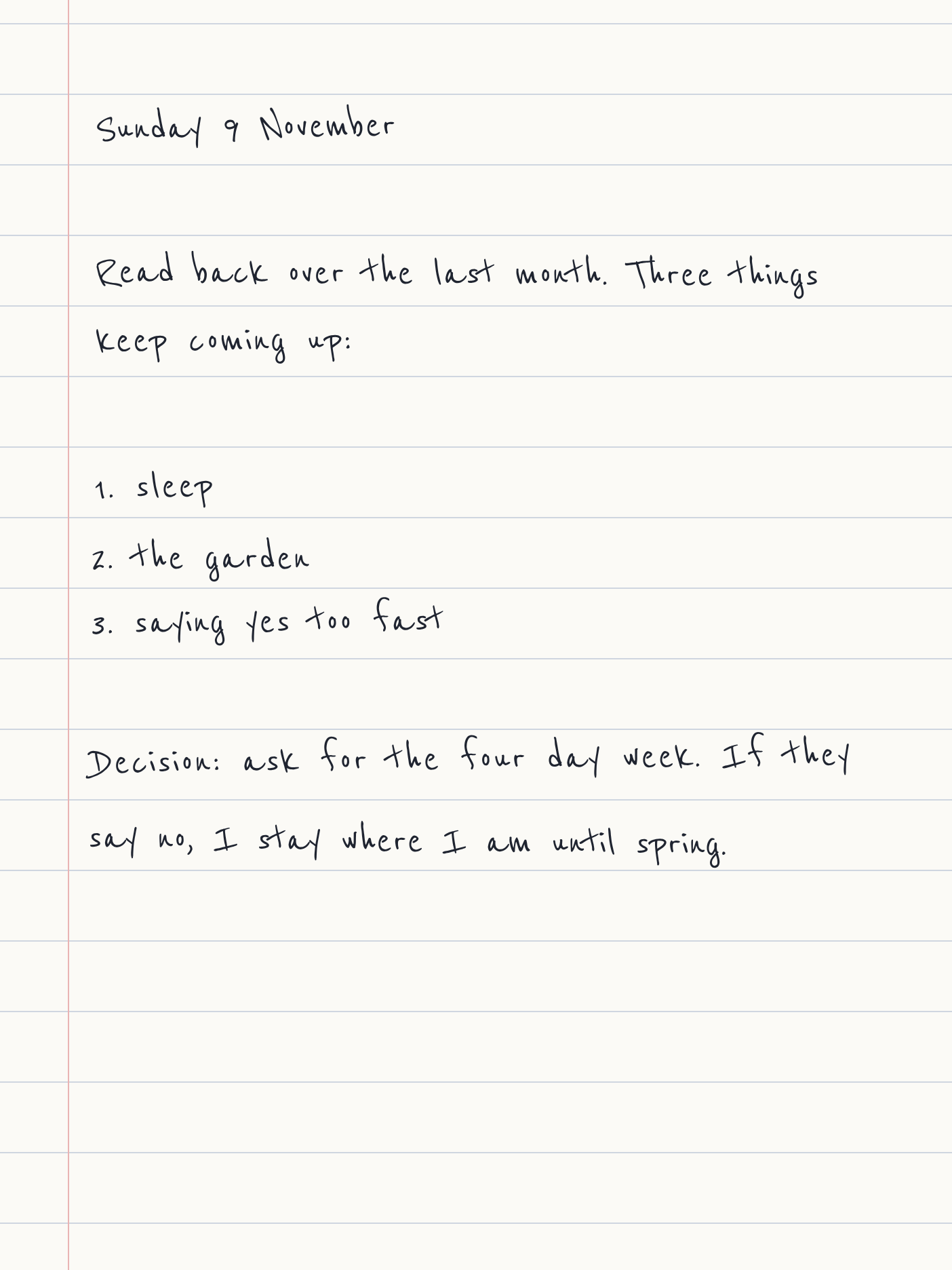
- On the last day, read back and write what you notice.
If writing about something leaves you feeling worse for more than a day or two, stop, and consider talking to someone qualified. Journaling is not treatment.
The reading back
The step most people skip is the fourth. Patterns only show across weeks, and paper is hard to reread: you can’t search it, and nobody leafs through six notebooks to count how often they wrote about sleep.
That is the gap Searchable Ink is for. You keep writing by hand; your pages become text you can search and read back in one place. How to reread your journal goes into what to look for.